

Hi, society!
april 2026
Flour, Form, and High-Fashion: Inside the Avant-Garde Overhaul of Manamita Baking School
By Julian Thorne, Culinaria & Style Correspondent
RIKIVI
4/6/20265 min read
Flour, Form, and High-Fashion: Inside the Avant-Garde Overhaul of Manamita Baking School
By Julian Thorne Culinaria & Style Correspondent
NEW YORK — On a nondescript corner in a neighborhood better known for its industrial lofts than its patisserie, a revolution is rising—and it’s perfectly proofed. The Manamita Baking School, a name once whispered only in the circles of elite pastry apprentices, has become the epicenter of a bizarre, beautiful, and highly photogenic collision between the world of Michelin-star technique and Parisian runway aesthetics.
To walk through the heavy oak doors of Manamita is to enter a space where the scent of fermenting yeast meets the sharp, ozone tang of high-fashion photography. The school, founded by the enigmatic Master Baker turned creative director, Kenji Manamita, has undergone a metamorphosis. No longer just a place to learn the hydration levels of a sourdough starter, it has become a stage for what Kenji calls "The Choreography of the Crust."
The Aesthetic of the Apron
The school’s recent notoriety is due in no small part to its unofficial muse: a male model whose stoic, sharp-featured presence has become as much a fixture of the kitchen as the industrial Hobart mixers. On any given Tuesday, you might find him posing against the stainless steel refrigerators, draped in oversized, architectural wools and white-rimmed opticals that scream Comme des Garçons more than Le Cordon Bleu.
"We are teaching them that baking is an act of presentation," says Manamita, gesturing toward a student who is currently trying to navigate a metallic spatula around the model’s couture-clad frame. "A cake is a sculpture. A croissant is a textile. Why shouldn't the baker look as refined as the brioche?"
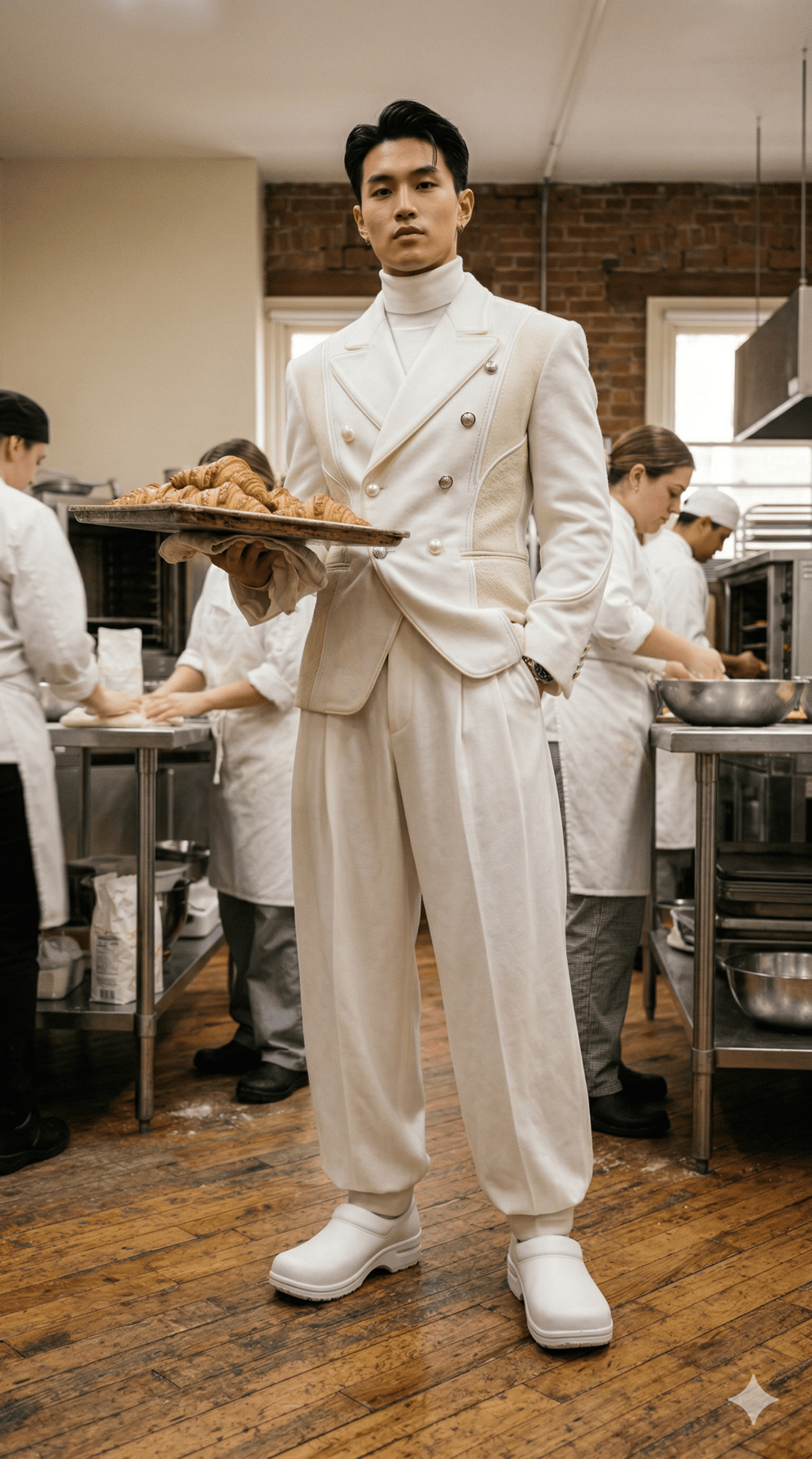
The fashion at Manamita is "chef-core" taken to its logical, luxury extreme. Traditional double-breasted coats are reimagined in heavy, structured creams with pearl buttons; trousers are pleated and voluminous, allowing for movement while maintaining a silhouette that belongs in a gallery. Even the footwear—a high-fashion take on the utilitarian chef’s clog—is rendered in pristine, matte white leather that seems defies the laws of flour-dust physics.


The Tension of the Tray
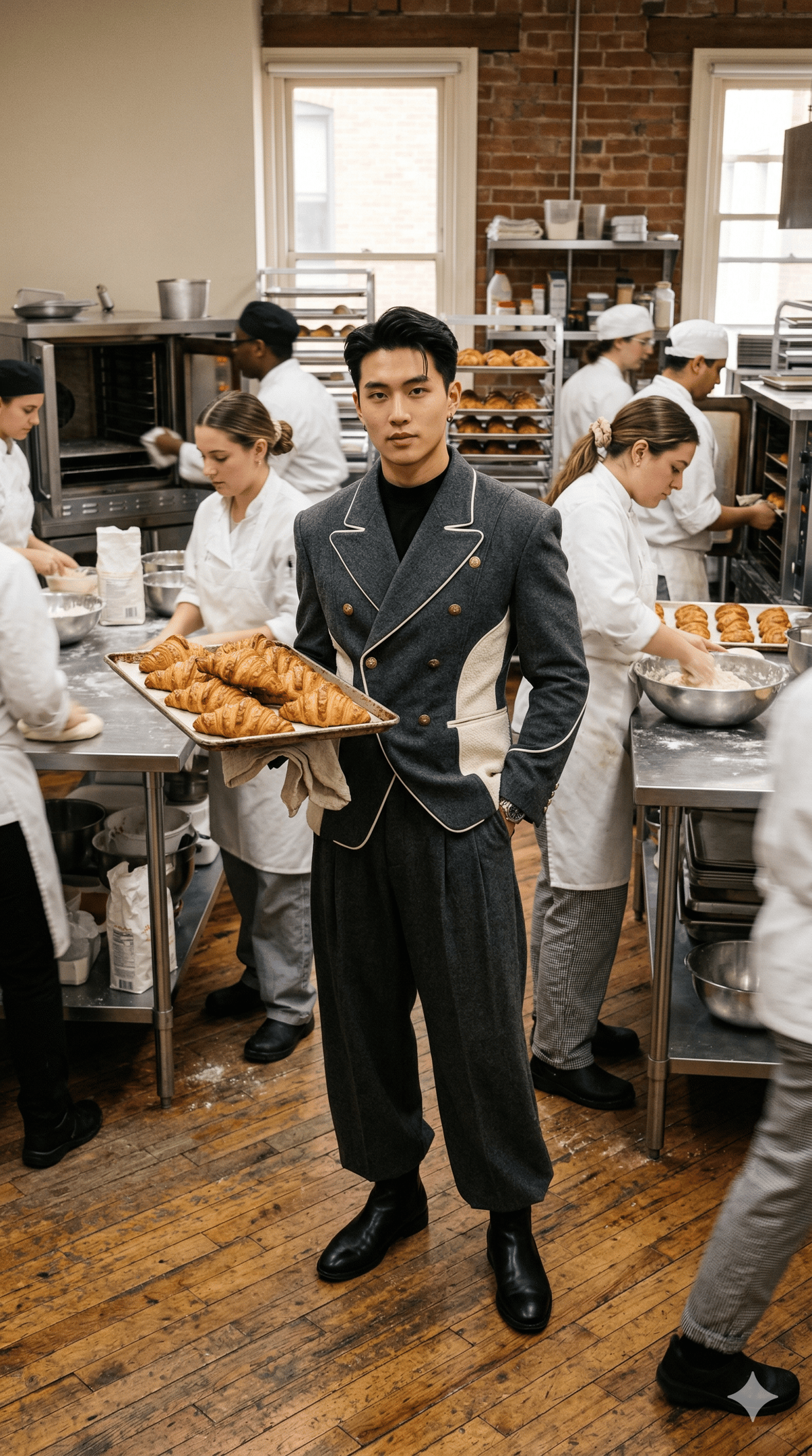
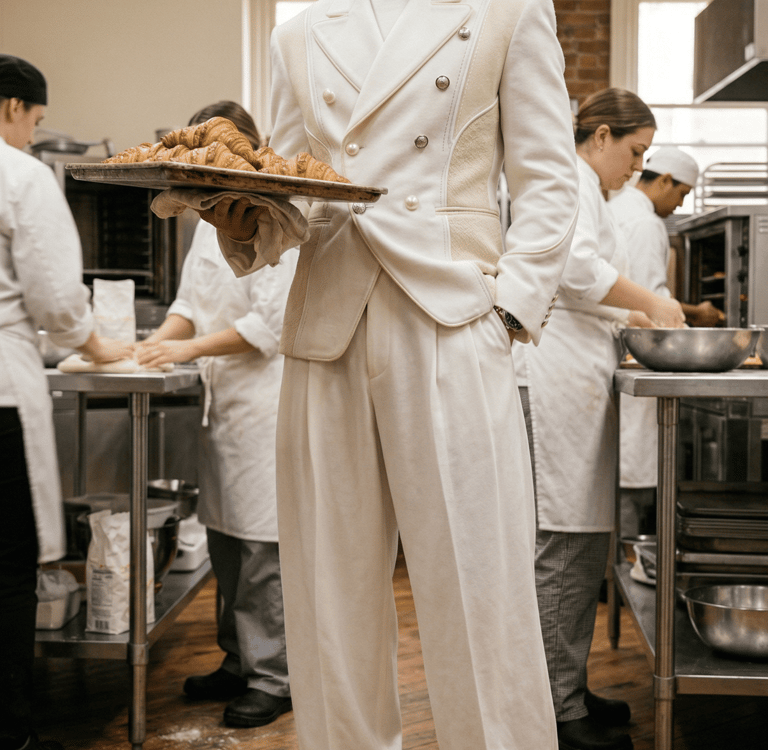
The atmosphere inside the workshop is one of controlled chaos and intentional irony. In one corner, the model stands motionless, a tray of golden, flaky croissants balanced on one hand. He is a pillar of stillness. Around him, the actual students—dressed in more traditional, albeit impeccably clean, whites—blur past. They ignore him with a practiced, professional indifference.
"At first, it was distracting," says Elena, a third-year student specializing in Viennoiserie. "You’re trying to check the internal temperature of a deck oven, and there’s a man looking like a structural masterpiece holding your tray of croissants. But now? He’s just part of the environment. He’s the standard of excellence we aim for in our plating."
This "ignoring of the icon" has become a signature of the Manamita brand. It creates a visual tension: the raw, sweating reality of a working kitchen versus the cold, polished perfection of the fashion industry.
The Pink Cake Incident
One of the school's most talked-about curriculum shifts involves the "Intervention Series." This is where students must interact with the "Ideal Form"—the model—while performing high-stakes tasks.
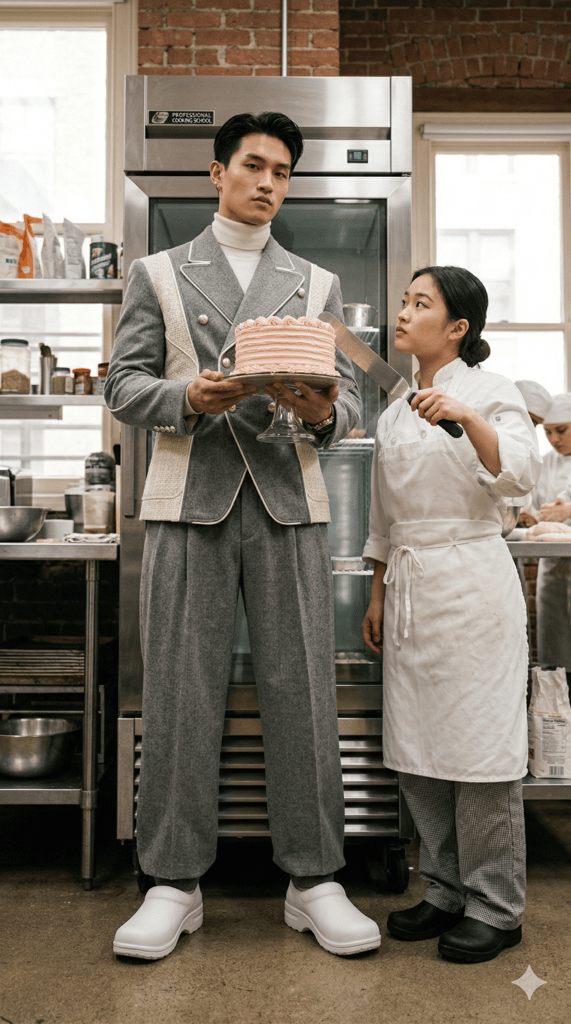
Recently, the school’s social media channels exploded after a photo surfaced of the model holding a delicate, tiered pink cake on a glass stand. A petite student stood beside him, her face a mask of intense concentration, spatula raised like a surgeon’s scalpel. The model looked into the distance, a gray and white wool coat draped over his shoulders, while she prepared to dismantle his cargo.
"It’s about nerves," Manamita explains. "If you can slice a delicate sponge cake while a six-foot-tall man in $4,000 trousers is judging your every move with his presence alone, you can handle a wedding at the Plaza."
A Sugar-Raised Renaissance
Despite the heavy emphasis on visual identity, the bread-and-butter (literally) of the institution remains its technical prowess. You cannot graduate from Manamita simply by looking good in a beret. The "Donut Examination" is a rite of passage that tests both the palate and the nerves.
In this final test, the model—often seen donning white-rimmed glasses and a loosely tied silk tie—is presented with a tray of twelve sugar-raised donuts. The students must watch as he prepares to take a bite. It is a moment of pure sensory theater. The donuts must be light enough to be "cloud-like" but structured enough to hold the sugar coating without collapsing under the model’s discerning gaze.
The school's philosophy is that the modern chef is a public figure. In an age of social media and open-concept kitchens, the "back of house" is now the "front of house." By integrating a high-fashion sensibility into the curriculum, Manamita is preparing its students for a world where the chef is the brand.
The Manamita Legacy
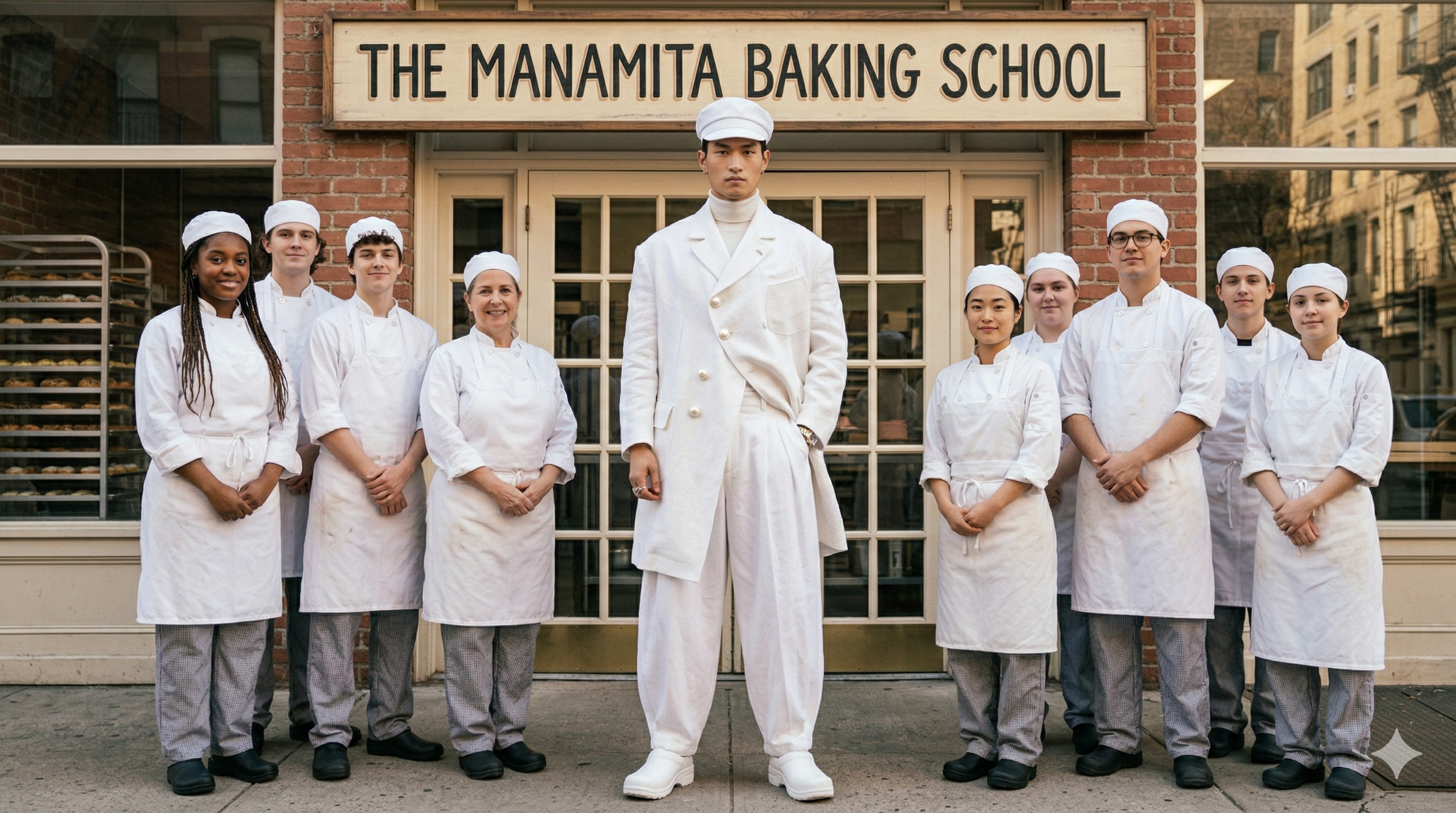
The exterior of the school remains humble—a brick facade with a simple wooden sign that reads THE MANAMITA BAKING SCHOOL. But the crowds gathering outside suggest something more is happening. Fashion students from nearby design colleges often loiter near the entrance, hoping to catch a glimpse of the "Baking Brigade" as they exit.
Flanked by his students, the lead model often stands at the front door for the morning roll call. Dressed in all-white, oversized silhouettes that evoke a sense of monastic purity, the group looks less like a class and more like a movement.
"We are not just making bread," Kenji Manamita says, watching his students file out onto the New York sidewalk. "We are making a statement. We are telling the world that the most beautiful things in life are those that are consumed—whether it’s a look or a loaf of bread. Both require heat, both require time, and both must be handled with style."
As the sun sets over the city, the flour settles on the wooden floors of the school. The models depart, the students scrub the stations, and the ovens cool. But the influence of Manamita stays in the air—a reminder that in the modern world, the most upscale thing you can be is someone who knows exactly how to balance the weight of a tray and the weight of a gaze.
If You Go: The Manamita Experience
Location: 42nd St. Annex, Lower East Side.
What to Order: The "Couture Croissant"—available only on Friday mornings.
The Dress Code: Aprons are provided, but sharp tailoring is encouraged.